Svalbard Weather Month by Month (2026)
Svalbard is warmer than it has any right to be and colder than it feels on paper, and both facts have the same cause.
 Verified by Lars Hansen, Norway tour specialist covering Arctic Norway and Svalbard
Short answer
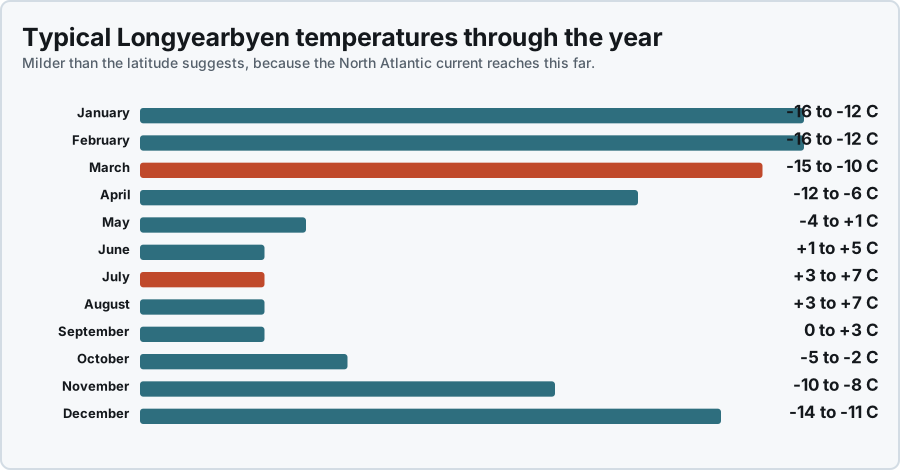
Longyearbyen is milder than its latitude suggests because the North Atlantic current reaches this far north. Typical winter days sit between -16 and -10 degrees Celsius and summer days between +3 and +7. What actually decides how cold you feel is wind: there are no trees and no shelter anywhere, so a moderate breeze at -12 is far worse than a still day at -20.
At 78 degrees north you would expect Siberian cold. Longyearbyen in January typically sits around -14 °C, which is a normal winter day in Helsinki and warmer than plenty of places in Canada that are a thousand miles further south. The North Atlantic current pushes warm water this far up, and it holds the whole archipelago in a milder band than the map implies.
Then the wind gets up off the fjord, there is nothing between you and it, and the thermometer stops being the relevant number.
What is the weather like in Svalbard?
Milder than the latitude suggests and windier than almost anywhere. Typical Longyearbyen winter days run -16 to -10 °C and summer days +3 to +7 °C. Precipitation is low, so this is technically an Arctic desert, but wind and cloud are constant factors and both decide whether tours run.
| Month | Typical range | Light | What it feels like |
|---|---|---|---|
| January | -16 to -12 °C | Polar night until about the 29th | Dark, dry, cold. Still days are fine, windy ones are not. |
| February | -16 to -12 °C | Long blue twilight | The coldest month in practice, and the most beautiful light |
| March | -15 to -10 °C | Daylight returning fast | Deep snow, bright, the best all-round conditions |
| April | -12 to -6 °C | Midnight sun from the 20th | Warming, snow still good, glare becomes an issue |
| May | -4 to +1 °C | Midnight sun | Thaw. Slush, meltwater, and the awkward gap between seasons. |
| June | +1 to +5 °C | Midnight sun | Tundra emerging, ice clearing from the fjord |
| July | +3 to +7 °C | Midnight sun | The warmest month, and still cold on the water |
| August | +3 to +7 °C | Midnight sun ends about the 22nd | Warm, wet-ish, the wettest month of a dry year |
| September | 0 to +3 °C | Real nights return | Changeable. Boat cancellations peak. |
| October | -5 to -2 °C | Light fading fast | Grey, quiet, the least on offer |
| November | -10 to -8 °C | Polar night from the 11th | Freezing in, dark, snow building |
| December | -14 to -11 °C | Polar night | Dark and dry. Christmas in Longyearbyen is genuinely something. |
Live conditions are worth checking before you fly, and yr.no's Longyearbyen forecast from the Norwegian Meteorological Institute is the source residents use.
Why does wind matter more than temperature?
Because there is nothing to shelter behind. Svalbard has no trees, and the valleys funnel wind off the fjord and the icefields. A still day at -20 °C is comfortable in the right clothing. A twenty-knot wind at -12 °C is not, and it is what cancels tours.
This is the single most useful thing to understand before packing. Insulation handles cold. Only a windproof outer layer handles wind, and it is the layer people most often skimp on because the temperature forecast did not look alarming.
| Condition | Air temp | How it feels | Effect on tours |
|---|---|---|---|
| Still, clear, winter | -20 °C | Manageable with layers | Everything runs |
| Windy, winter | -12 °C | Considerably worse than -20 still | Boats cancelled, snowmobiles marginal |
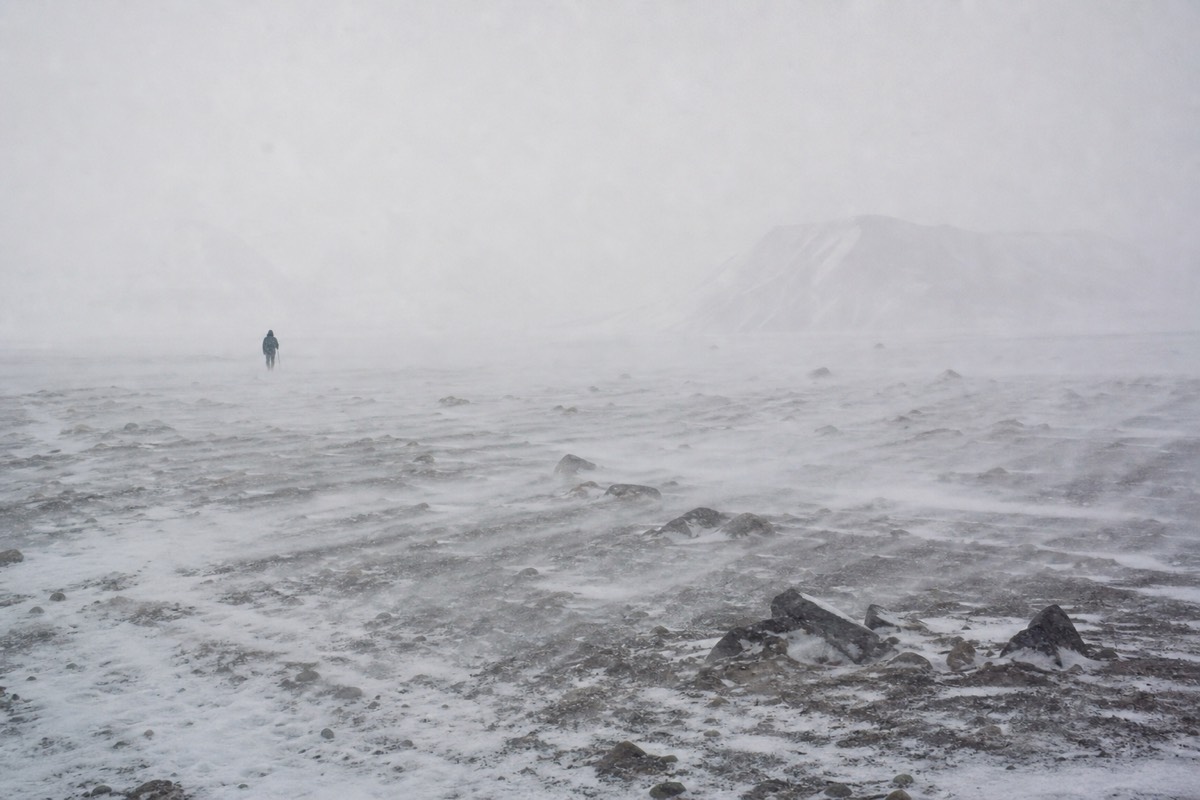
| Whiteout | Any | Zero visibility, disorienting | Snowmobiles and hikes cancelled |
| Still, overcast, summer | +5 °C | Fine | Everything runs |
| Windy on the water, summer | +5 °C | Cold enough to end a boat day early | Boats cancelled |
| Clear winter night | -18 °C | Cold while standing still | Best possible aurora conditions |
What weather cancels Svalbard tours?
Wind on Isfjorden stops the boats and is the most common cause by a wide margin. Whiteout and heavy snow stop snowmobiles and hikes. Unstable ice closes caves. Cloud does not cancel an aurora tour but it does empty it of purpose, which is why you book more than one night.
| Cancels | Which tours | How often |
|---|---|---|
| Wind on the fjord | Boat tours, sea-floating | The most common cause. Summer weeks lose days regularly. |
| Whiteout, heavy snow | Snowmobile, hiking, aurora | Frequent in mid-winter |
| Unstable glacier ice | Ice caves | Occasional, and can close a specific cave for a season |
| Cloud | Northern lights, which runs anyway | Very common. Book two evenings. |
| Almost nothing | Longyearbyen town, mine and Seed Vault tours | The reason to hold one in reserve |
Operators here reschedule or refund rather than push a marginal day, and 58 of the 62 listings carry free cancellation. The practical consequence is covered properly in how many days you need: book your priority trip early in the stay, never on your last morning.
Clear cold nights are also what the aurora needs, and the most reviewed chase runs 4.6 across 36 reviews from about $205, so check price and dates here if you are travelling in the dark season. The one category that reliably survives is underground. The Gruve 3 coal mine tour runs year-round at 4.8 across 491 reviews, and if you want a weatherproof anchor for the itinerary you can check live availability and prices on GetYourGuide.
Which month has the best weather?
March for winter conditions and July for summer. March gives deep reliable snow, returning daylight and relatively settled weather. July is the warmest and the driest-feeling, with the fjord open and the light constant. September is the most changeable month of the year and the one where cancellations peak.
"Best weather" and "best trip" are not the same question. February is colder and darker than March and has the most extraordinary light of the year. September has the worst reliability and the only overlap between boats and aurora. The trade-offs are worked through in the best time to visit guide and month by month on the season comparison.
What should you wear for the conditions?
Layers, with a genuinely windproof outer. Merino base, fleece or wool mid, windproof shell. On snowmobile, boat and ice-cave tours the operator supplies the outer thermal suit, so you are buying the inside of the system rather than the outside.
The failure points in Svalbard are always the same: fingers, toes and face, and they fail during the stops rather than while you are moving. Liner gloves under mitts, two pairs of wool socks used one at a time, and something over the face on any snowmobile trip. The full list is in the packing guide.
Common questions about Svalbard weather
How cold does Svalbard get?
Typical winter days in Longyearbyen sit between -16 and -10 degrees Celsius, which surprises people who expect worse from 78 degrees north. The North Atlantic current is the reason. Colder snaps happen, and the interior and east coast run colder than the town, which is why the ten-hour east coast snowmobile expeditions are described as serious days rather than activities.
Does it rain in Svalbard?
Rarely, and only really in summer. Precipitation across the archipelago is low enough that it qualifies as an Arctic desert, and August is the wettest month of a dry year. What you get instead is wind-driven snow in winter and low cloud in summer, both of which affect tours more than rain would.
Is Svalbard warmer than Antarctica?
Considerably, and for the same reason it is warmer than most places at its latitude: ocean currents. Longyearbyen's winter average is comparable to a cold northern European city, while interior Antarctica is in a different category entirely. Visitors expecting polar extremes often find the temperature the least difficult part of the trip.
What is the wettest and driest month?
August is the wettest, in relative terms, and the late winter months are the driest. Because total precipitation is low year-round, the practical planning question is almost never rain. It is wind, which cancels boats, and visibility, which cancels snowmobile and hiking trips.
Should I check the forecast before booking a tour?
Check it, but do not act on it more than a day or two out. Arctic forecasts beyond about 48 hours are unreliable, operators make their own calls on the morning, and a forecast that looks poor often produces a workable day. Since almost every listing cancels free, the better strategy is booking ahead and letting the operator decide, rather than trying to time it yourself.