Inside a Svalbard Ice Cave, and Why It Is Different Every Winter
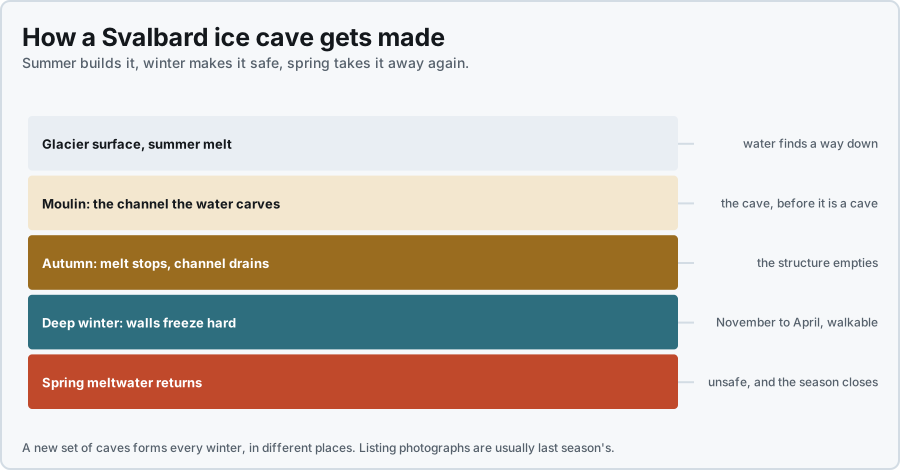
A Svalbard ice cave is a meltwater channel that froze. That single fact explains the season, the safety rules, and why no operator can promise you the cave in the photograph.
 By Lars Hansen, Norway tour specialist covering Arctic Norway and Svalbard
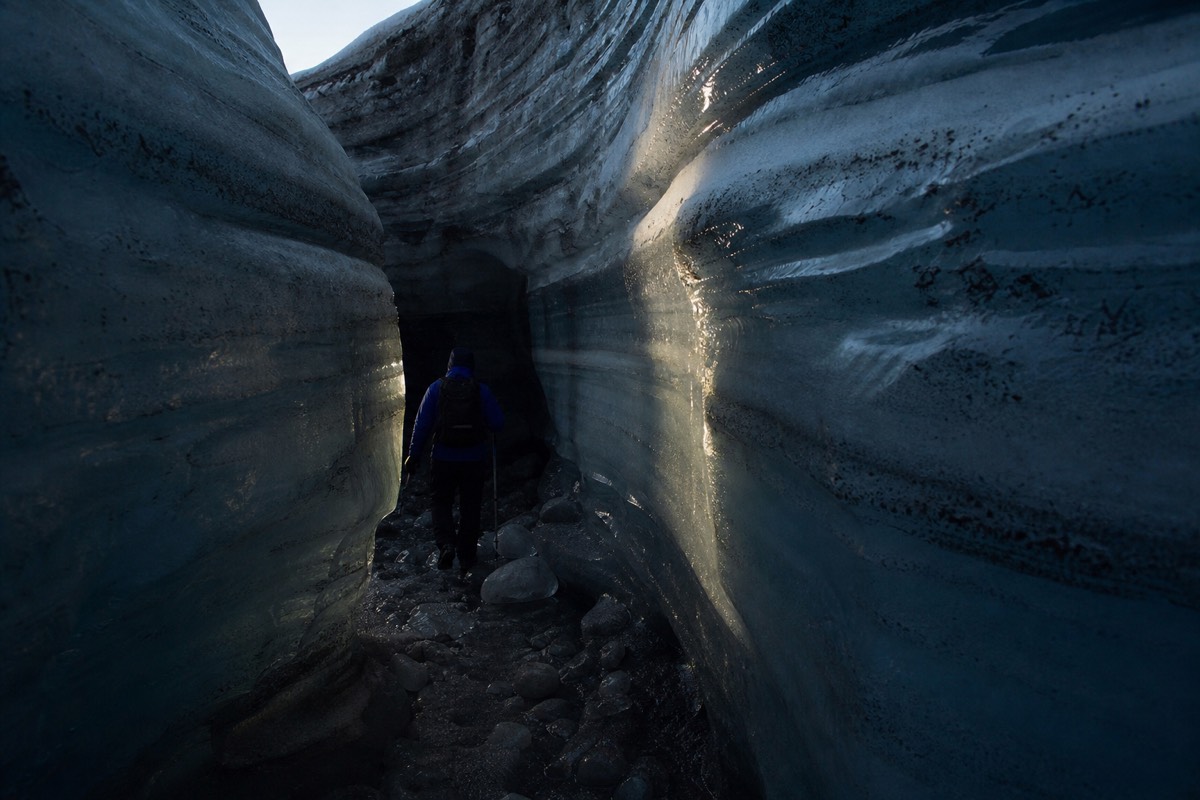
The photograph you have seen is real and it is also historical. Somebody took it in a specific chamber, in a specific winter, in a cave that has since collapsed, flooded or refrozen into something else entirely. Svalbard's ice caves are not features. They are events.
That is the single thing worth understanding before booking one, and it changes how you read every listing.
A cave here is a meltwater channel that froze
During summer, melt on the glacier surface finds a way down and carves a channel through the ice, a moulin. When the melt stops and the deep cold arrives, that channel drains, freezes hard and becomes something a person can walk into.
Which means the cave is made by summer and made safe by winter, and it is remade every single year in a slightly different place, at a slightly different size, with a slightly different shape. Operators go looking each autumn. Some winters produce a spectacular chamber. Some produce a crawl.
| Stage | When | What happens |
|---|---|---|
| Formation | Summer melt | Water carves a channel down through the glacier |
| Drainage | Autumn | Melt stops, the channel empties |
| Freezing | Late autumn to early winter | The walls harden, the structure stabilises |
| Season opens | Roughly November to December | Guides assess and start running trips |
| Peak | February and March | Deepest cold behind it, enough daylight for the approach |
| Season closes | Roughly April | Spring meltwater returns and it becomes unsafe |
Two ways in, and they suit different people
You either ride to the glacier snout on a snowmobile or you snowshoe in from the road. The cave at the end is the same kind of thing; the day is not.
| By snowmobile | On snowshoes | |
|---|---|---|
| Real from-price | $399 to $473 | $272 to $300 |
| Total time | 2.5 to 7 hours | 3.5 to 5 hours |
| Licence needed | Category B car licence, carried | None |
| Effort | Low while riding, moderate underground | Moderate throughout. Uphill in powder is work. |
| What you notice | Distance, speed, ground covered | Silence, detail, the sound of your own breathing |
| Season | Late January to April | November to April, the longer window |
The snowshoe route is the cheaper and quieter way in, rated 4.9 across 11 reviews from about $300, and you can check price and dates here. Dennis, from Austria, wrote about the snowmobile version in February 2026 and made a comparison that is worth quoting because it is specific about value rather than adjectives: "This private tour is very informative / the guides gave a lot of information. The great thank is that you go in the cave private and not with 20 people [...] We went in the cave in the morning at 8am where no people were there. Very friendly guides!"
Going in at eight in the morning with nobody there is the argument for the private version. Whether it is worth the difference depends on how much you mind sharing a passage.
What it is actually like in there
Cold, still and blue. The stillness is what surprises people: outside there is always wind in Svalbard, and inside a glacier there is none at all, so the temperature feels warmer than the ride in even though it is hovering near freezing.
The blue is not decorative. Glacier ice under pressure for centuries has had the air squeezed out of it, and what is left absorbs the red end of the spectrum and lets the blue through. Banding runs through the walls where seasonal layers compressed at different rates. A head torch makes it glow; turning the torches off makes it disappear entirely.
Practical realities the photographs do not convey:
- Crampons, and you will need them. The floor is ice, sometimes at an angle.
- Helmets, for a reason. Passages narrow and the ceiling comes down.
- Some caves involve crawling. Not all, and it varies year to year. Ask.
- It is dark in a way you have not experienced. All the light is what you brought.
- Photography is hard. High contrast, no ambient light, and phone night modes struggle with the ice texture.
The season, and why it is short
Roughly November to April, which is narrower than the winter it sits inside. Too early and the caves have not frozen stable. Too late and meltwater is coming back through them.
February and March are the dependable middle: the deepest cold is behind you, the structures are as solid as they get, and there is enough daylight to make the approach comfortable rather than a head-torch expedition in both directions.
| Month | Ice caves running? | Notes |
|---|---|---|
| November | Starting, snowshoe access | Depends on how hard the freeze came |
| December to January | Yes | Full polar night. Approach and cave are both dark. |
| February to March | Peak | The reliable window. Book here if you can choose. |
| April | Yes, tailing off | Warming, and operators watch conditions closely |
| May onwards | No | Meltwater. The cave that existed is gone. |
The five bookable listings are on the ice cave and glacier page, and if the best-rated snowmobile version is what you want you can check live availability and prices on GetYourGuide for your dates.
Why you cannot go in alone
Two reasons, and both are firm. Glacier travel means crevasse risk, and a crevasse under snow is invisible until you are in it. And the glacier snouts are all well outside the settlement boundary, where the polar bear protection duty applies and being on an organised tour is what exempts you from carrying your own means of deterrence.
The requirement itself comes from the Governor of Svalbard, and the season dates follow Visit Svalbard's winter definitions. Every one of the five listings is guided, supplies crampons, helmet and head torch, and includes the approach. That is not upselling, it is the legal structure of moving around Svalbard.
Svalbard caves against Iceland's
People arrive having seen Iceland's crystal caves under Vatnajokull and expect a version of that. They are related and not the same.
| Svalbard | Iceland | |
|---|---|---|
| Scale | Smaller, tighter, more crawling | Larger chambers, more walkable |
| Season | November to April | Shorter, and shrinking with warming |
| Visitors | Very few. You may be the only group. | Popular, and it feels it |
| Getting there | Snowmobile or snowshoe from Longyearbyen | Coach and super-jeep from the ring road |
| Reliability | Varies by winter | Varies by winter, more operators hunting |
Svalbard's version is colder, harder to reach, less photogenic and considerably less crowded. You will not queue for one, and Dennis's eight o'clock morning with nobody there is genuinely available.
If ice caves are the reason you are going, the best time to visit guide sets out which month puts you in the window, and what to pack covers what goes under a supplied thermal suit.
Questions about Svalbard ice caves
Is a Svalbard ice cave claustrophobic?
Parts of some caves are. Passages narrow, and there are sections where you are on your hands and knees. It is not a lit commercial show cave and it is not a walk-in chamber either. Because the caves change every winter, the honest move is to message the operator through the listing and ask what they are running that week before booking.
How cold is it inside an ice cave?
Near freezing, and it usually feels warmer than the journey there because there is no wind at all. In Svalbard, wind is what makes cold hurt, and a glacier interior is the only genuinely still place outdoors. Keep the layers you rode in with; you will not overheat.
Will the cave look like the photograph on the listing?
Not necessarily, and no operator can promise it will. Caves are meltwater channels that reform in different places and shapes every winter, so listing photographs are usually from a previous season. That is not misleading so much as unavoidable. Ask what they are currently running rather than what is in the picture.