Aurora at Noon: The Thing Only Svalbard Does
Everywhere else you wait for night. In Svalbard's polar night there is no night to wait for, which changes what an aurora trip actually is.
 By Lars Hansen, Norway tour specialist covering Arctic Norway and Svalbard
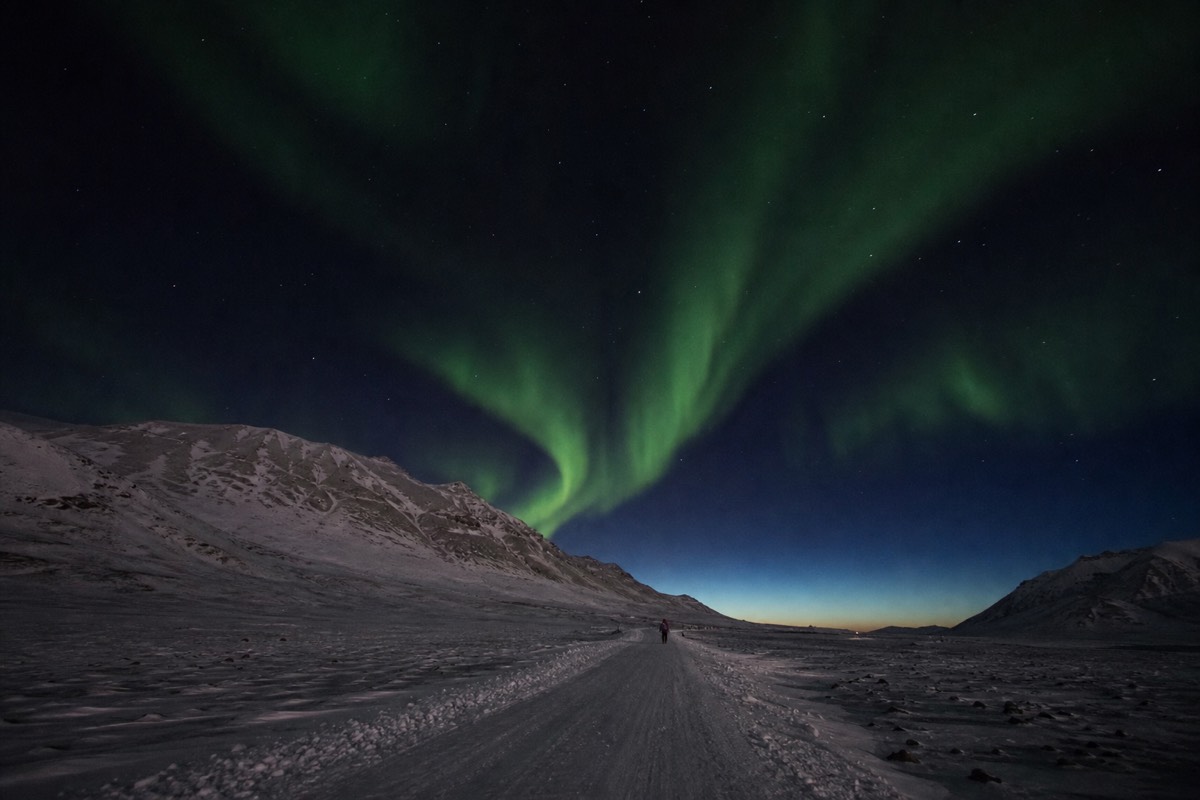
There is a photograph that circulates every winter of people in Longyearbyen walking to work under an aurora. It is not a trick and it is not taken at three in the morning. It is eleven o'clock, on an ordinary Tuesday in December, and the northern lights are simply out because there is nothing to hide them.
That is the whole reason to choose Svalbard over Tromso for an aurora trip, and it is worth being precise about, because the other reasons people give are mostly wrong.
Svalbard is not the best place to see the aurora
It is the most unusual place, which is different. The auroral oval is a ring, not a cap, and Longyearbyen at 78.22 degrees north sits slightly beyond the ring's most active band. On an average clear night, mainland Arctic Norway often performs better.
Anyone telling you that further north automatically means more aurora is describing a hemisphere they have imagined rather than the one that exists.
| Svalbard | Tromso and Lofoten | |
|---|---|---|
| Position relative to the oval | Slightly north of the busiest band | Close to the centre |
| Odds on an average clear night | Good | Better |
| Season length | Late Oct to mid-Feb | Late Sep to early Apr |
| Aurora during daylight hours | Yes, in polar night. Nowhere else. | No |
| Light pollution | Almost none. One small town, no trees. | More settlement, more trees |
| Cost of getting there | Considerably higher | Lower |
So the honest pitch for Svalbard is: fewer photons, better circumstances, and one phenomenon that exists nowhere else inhabited. The season dates come from Visit Svalbard, and the cloud forecast that actually decides your evening from the Norwegian Meteorological Institute.
What polar night actually does
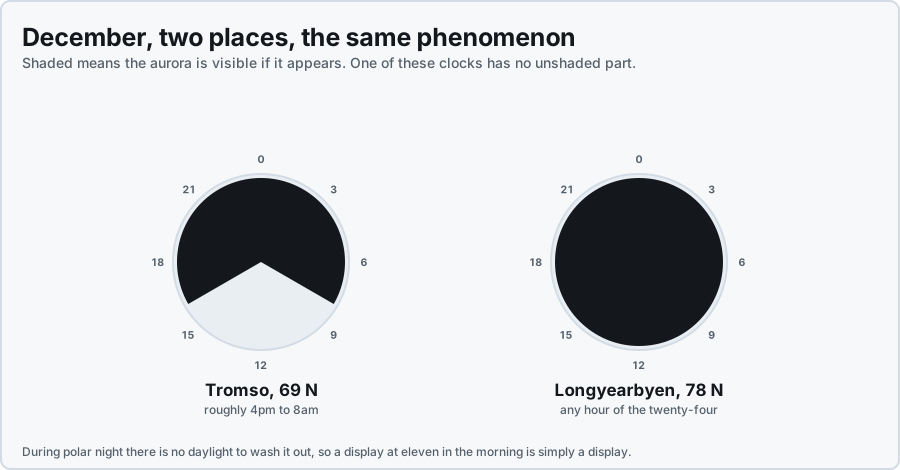
From about 11 November to 29 January the sun does not rise at Longyearbyen. Not "rises briefly", not "twilight". For most of that stretch it is dark around the clock, and darkness is the only ingredient an aurora display needs from you.
Svalbard also sits far enough north to catch dayside cusp aurora, which is a genuinely different phenomenon from the evening displays further south and is why research observatories sit up here. For a visitor the practical effect is simply that the aurora has no schedule.
| Where you are | When aurora is possible |
|---|---|
| Tromso, December | Roughly 4pm to 8am |
| Reykjavik, December | Roughly 5pm to 9am |
| Longyearbyen, December | Any hour of the twenty-four |
| Longyearbyen, June | Never. Midnight sun. |
Cloud is the enemy, not darkness
Every honest aurora review from Svalbard says the same thing in different words. Kristin, from the United States, in December 2025, on the most-reviewed listing:
"Our guide Eirik was fantastic. He was very knowledge about the area and took us several different places for chances to see the northern lights. While the clouds impacted visibility, we still had a wonderful time on this tour. There was also a full moon which allowed for some excellent landscape photography."
Clouds impacted visibility. That is the recurring line, and it is why the single most useful thing you can do is book more than one evening. Three nights in Longyearbyen during the dark season turns a coin toss into a reasonable bet, and since 58 of the 62 listings carry free cancellation, booking two and dropping one costs nothing.
| Strategy | Cost | Effect |
|---|---|---|
| One guided evening | About $205 | A coin toss on cloud |
| Two guided evenings | About $410, refundable | Substantially better |
| Three nights in town, two tours | Same tours, one more night | The realistic minimum for a serious attempt |
| One night trip built around aurora | The whole trip | Not advisable |
What the tours actually buy you
Distance from the streetlights, a guide watching conditions across several valleys, and on the photography version, somebody who will set up your camera properly.
That last one matters more than it sounds. Aurora photography is long-exposure work in the cold, and the gap between what a phone captures and what a manually configured camera on a tripod captures is enormous. Maggie, from China, in March 2026: "Fantastic we saw northern lights with different colors and we stopped at several major spots such as Global Seed Vault for photos."
| Option | Time | From-price | Best for |
|---|---|---|---|
| Photography tour by car | 4 hours | $205 | Anyone with a camera they do not fully understand |
| Private chase by car | 3 hours | $233 | Couples, and route flexibility |
| Aurora by snowmobile | 2.5 hours | $263 | Two experiences in one evening |
| Camp Barentz dinner (Viator) | 3 hours | On the listing | A guaranteed good night even under cloud |
If you would rather the ride were half the evening, the aurora run by snowmobile costs about $263 for two and a half hours: check availability here. The Camp Barentz option is the hedge. It is a two-course dinner at a wilderness camp with the aurora as a possibility rather than the entire product, which means a clouded-out evening is still an evening. The full set is on the northern lights tours page, and if the photography tour is what you want you can check live availability and prices on GetYourGuide.
The cold nobody warns you about
An aurora tour is the coldest thing you will do in Svalbard and it involves no exertion at all. That is exactly the problem. On a snowmobile you are generating heat and wearing a supplied thermal suit. On an aurora chase you are standing in a field at -15 °C for forty minutes with your hands out of your gloves operating a camera.
Dress for standing, not for walking. Liner gloves under mitts so you can work a camera without exposing skin. Spare batteries in an inside pocket, because cold flattens them and they often revive once warm. A bag for the camera before you carry it into a heated vehicle, or condensation fogs the sensor. The full list is in what to pack.
When to come
Late October to mid-February, and the answer inside that depends on what else you want.
- December and January are peak polar night. Maximum strangeness, aurora at any hour, and almost nothing else outdoors running.
- Late January to mid-February is the only window where aurora season overlaps the returning snowmobile season. If you want both, this is it.
- February has the last of the aurora and the most beautiful blue-hour light of the year.
- March onwards is effectively over for aurora, and is the best month for everything else.
The trade-off is worked through in the best time to visit guide, and what polar night is actually like covers the rest of the experience, which turns out to be the part people remember.
Questions about the Svalbard aurora
Can you really see the aurora during the day in Svalbard?
Yes, during polar night, roughly 11 November to 29 January, because there is no daylight to compete with it. A display at eleven in the morning is simply a display. Svalbard also catches dayside cusp aurora, which is a distinct phenomenon from the evening lights seen further south, and is one reason research observatories are sited here.
How many nights do I need for a decent chance?
Three, minimum. Cloud dominates the outcome and it is not predictable more than a day or two ahead. Two guided evenings across three nights is the sensible shape, and because almost every listing cancels free, booking both and dropping one if the first delivers costs nothing.
Is a guided aurora tour worth it, or can I just walk out of town?
On a strong night you will see something from a Longyearbyen doorstep, and residents photograph it constantly. What a tour buys is distance from the streetlights, someone monitoring conditions across several valleys, and on the photography version a guide who will configure your camera. On a weak display that difference decides whether you see anything.